
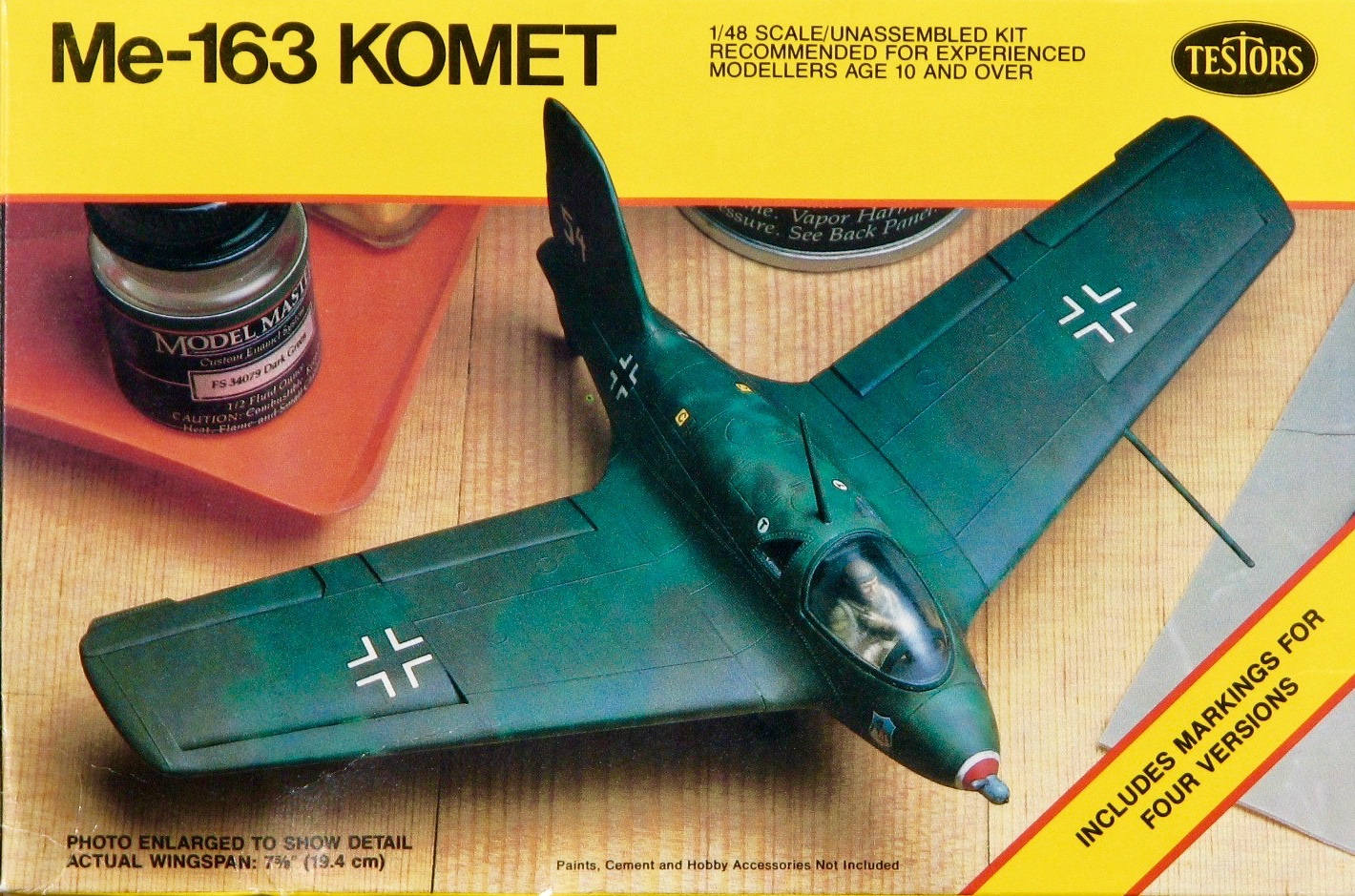
Testors Me-163 Komet
I want to preface everything I say here about WWII nazi aircraft. There were some amazing technological achievements, hard-won despite foolish leadership and disgusting purposes. I hate nazis, the third reich, hitler, the ss, anti-semitism, racism, and everything the axis powers stood for. It makes me angry, sad, and outraged that brilliant ideas and minds turned their work to the darkest purposes so far known to humanity.
The technological residue from the work these aircraft designers found its way into so much of the jet and space age that made the 20th Century a period of remarkable innovation. Captured German technology from things like the V2, Me 262 and Ho Horton 229 turned up in the American space program, the first American & British jet fighters, and the NM-1, YB-35 and YB-49 flying wings that eventually led to technological achievement of the B-2 bomber.
I need to be as clear as I can be: it’s the achievement of this technology, scientific and historical interest, and a love of aviation that brings me to this aircraft, not a fascination with a disgusting regime. It’s why I will never put a swastika on any historic German aircraft I build. Nazi ideology, old or new, has no place in my modeling.


Now, on to the Komet.
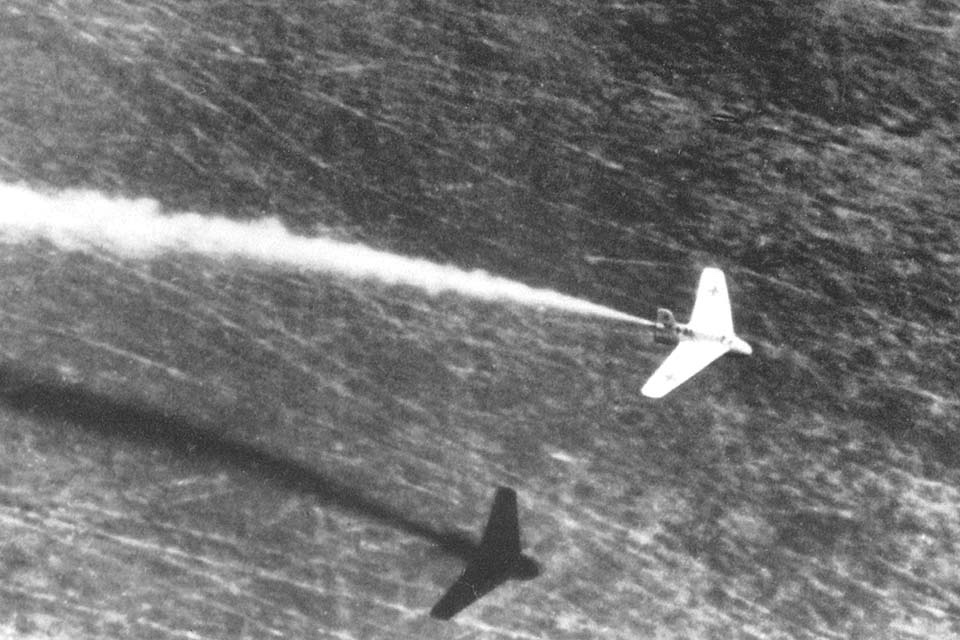
One of five V-series Me-163 test aircraft makes a low-level powered flight at the Peenemünde-West field near Germany’s Baltic Sea coast. (National Archives)
This aircraft has fascinated me for a long time. It’s the only one of its kind, born of all sorts of necessity, a real engineering marvel for its time, put to a horrible purpose. The Armistice of WWI only permitted Germany unpowered aircraft. German aircraft designers necessarily became designers of gliders.
Alexander Lippisch was one of the great glider designers and began the work on the Me 163. As a mostly tailless glider, it’s an odd bird already, but add to that it being the very first and only rocket powered fighter ever produced. Me 163s were filled in separate tanks with “T-Stoff” and “C-Stoff,” two volatile compounds that reacted violently with each other. So violently, the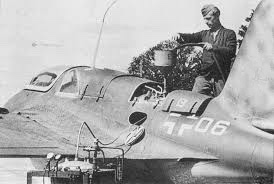 re were strict rules on refueling, ensuring the fueling trucks of the two were never together and that any spilled fuel of either kind was well washed away before the next was trucked in or put in the tank.


The Me-163 was a remarkably short-range fighter. It’s fast deployment made it valuable to Germany in defending factories. Unlike conventional prop fighters of the time, it could be in the sky engaging allied bombers in under 15 minutes. Unlike conventional prop fighters of the time, it could only remain in the skies for about another 15. Komets were placed on airstrips close to the factories they defended with pilots on constant alert, ready to fly at any moment.
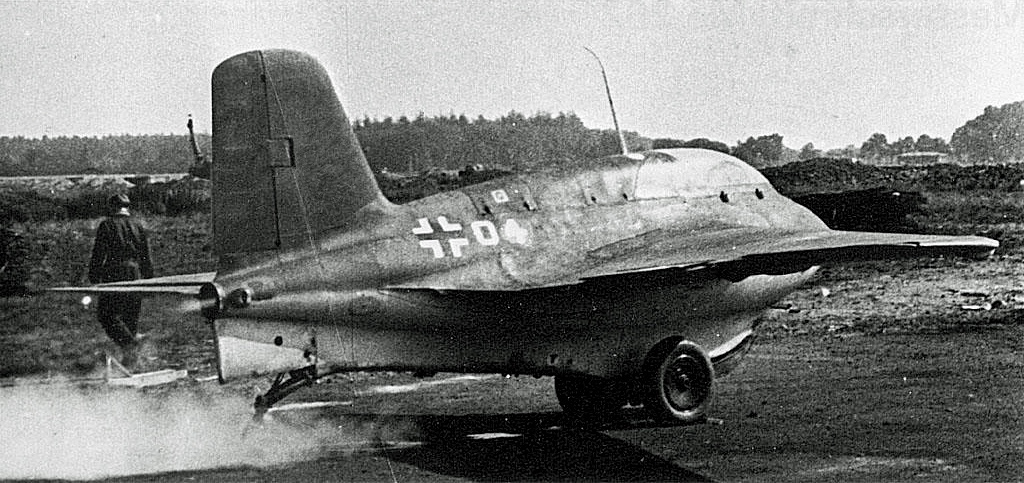 That flight experience was like nothing before. The thrust of the chemical rocket engine took the Me 163 from ground to a remarkable 39,000 feet at speeds up to and exceeding 550 mph. The Komet flew up into the bomber formation, would initiate a few firing runs on what fuel it had and then essentially became a glider again, gliding in a smooth arc back to the ground.
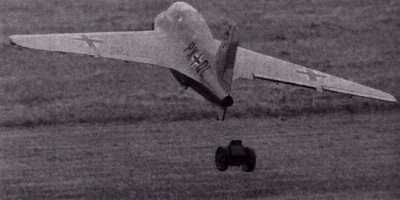 Seems like just what the axis needed at the time and the perfect aircraft to confound allied pilots, but it had remarkable limitations like most brand new technology. It took off on a wheeled dolly that it would jettison when it was up to airspeed for its climb. If pilots dropped the dolly too soon, it could bounce back and hit the Komet, causing instantaneous explosion of its chemical fuel.
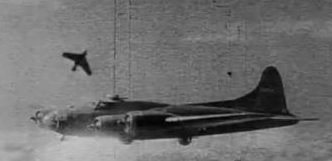 Coming upon the bombers for its attack run, the Komet was moving so fast relative to the prop planes it was attacking, it only had a split second to shoot before the target flashed by making it incredibly difficult to do more than harass bombers.
On the way back down in glide mode, the Komet was a sitting duck for escort fighters who picked them off, well, like ducks. If you did make to the ground as Komet pilot, you were then dependent on a skid dropping down into place as your landing gear or landing on the center rib of the fuselage. With no spring in the landing system, even with the skid down, more than a few Komet pilots suffered back injuries on these landings, some severely. You’d need to keep it upright until you slowed your skid enough to let a wingtip skid on the ground like a traditional glider. Mistakes here led to spins and flops of the aircraft.
All in all, a technological marvel, but sort of like rigging a manual typewriter as the keyboard for your computer; it’ll work, but it’s nasty.


The Testors kit I got was from the early 2000s I think and I only paid $2.50 on eBay for it! The box was beat up, and arrived both ends open; I was even worried about if all the parts were there, but there aren’t that many parts in this kit and it looks all there.
That said, $2.50 kit, new air brush ready for my first airbrush finished model? I’m feeling 0 restrictions. It’s time to have some fun!
 Scale Model Wings